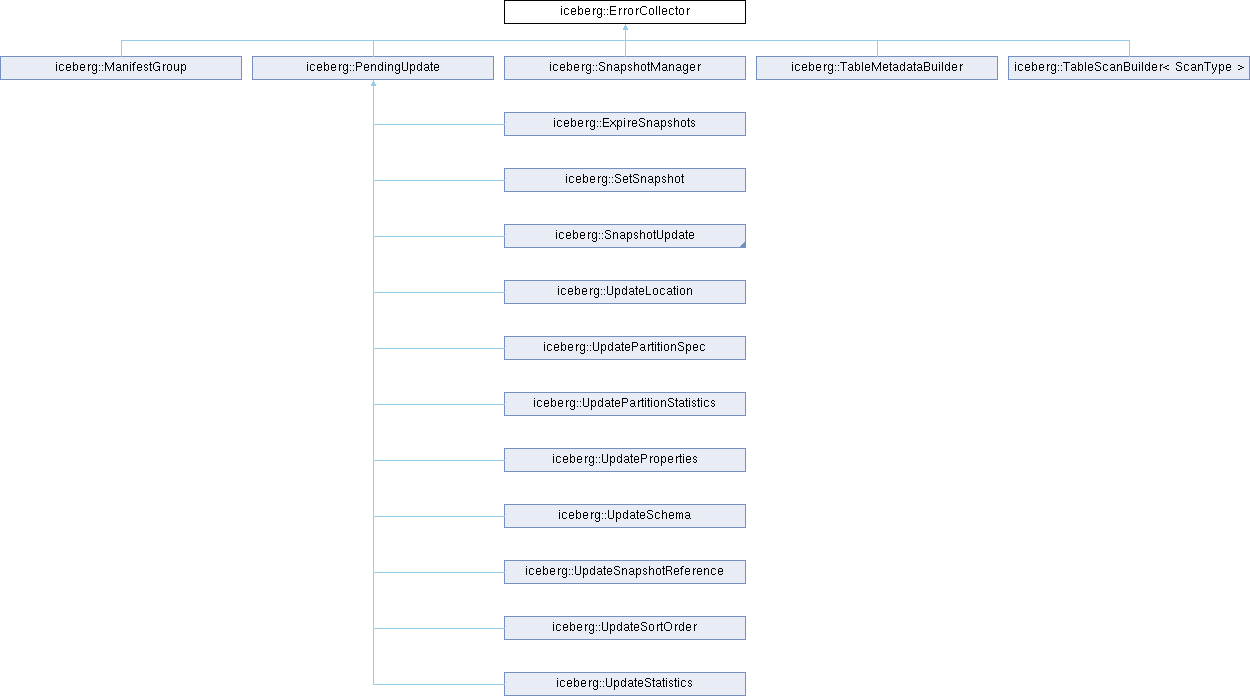
Base class for collecting errors in the builder pattern. More...
#include <error_collector.h>
Public Member Functions | |
| ErrorCollector (ErrorCollector &&)=default | |
| ErrorCollector & | operator= (ErrorCollector &&)=default |
| ErrorCollector (const ErrorCollector &)=default | |
| ErrorCollector & | operator= (const ErrorCollector &)=default |
| template<typename... Args> | |
| auto & | AddError (this auto &self, ErrorKind kind, const std::format_string< Args... > fmt, Args &&... args) |
| Add a specific error and return reference to derived class. | |
| auto & | AddError (this auto &self, Error err) |
| Add an existing error object and return reference to derived class. | |
| auto & | AddError (this auto &self, std::unexpected< Error > err) |
| Add an unexpected result's error and return reference to derived class. | |
| bool | has_errors () const |
| Check if any errors have been collected. | |
| size_t | error_count () const |
| Get the number of errors collected. | |
| Status | CheckErrors () const |
| Check for accumulated errors and return them if any exist. | |
| void | ClearErrors () |
| Clear all accumulated errors. | |
| const std::vector< Error > & | errors () const |
| Get read-only access to all collected errors. | |
Protected Attributes | |
| std::vector< Error > | errors_ |
Detailed Description
Base class for collecting errors in the builder pattern.
This class equips builders with error accumulation capabilities to make it easy for method chaining. Builder methods should call AddError() to accumulate errors and call CheckErrors() before completing the build process.
Example usage:
Member Function Documentation
◆ AddError() [1/3]
|
inline |
Add an existing error object and return reference to derived class.
Useful when propagating errors from other components or reusing error objects without deconstructing and reconstructing them.
- Parameters
-
self Deduced reference to the derived class instance err The error to add
- Returns
- Reference to the derived class for method chaining
◆ AddError() [2/3]
|
inline |
Add a specific error and return reference to derived class.
- Parameters
-
self Deduced reference to the derived class instance kind The kind of error fmt The format string args The arguments to format the message
- Returns
- Reference to the derived class for method chaining
◆ AddError() [3/3]
|
inline |
Add an unexpected result's error and return reference to derived class.
Useful for cases like below:
- Parameters
-
self Deduced reference to the derived class instance err The unexpected result containing the error to add
- Returns
- Reference to the derived class for method chaining
◆ CheckErrors()
|
inline |
Check for accumulated errors and return them if any exist.
This should be called before completing a builder operation (e.g., in Build(), Apply(), or Commit() methods) to validate that no errors were accumulated during the builder method calls.
- Returns
- Status indicating success if no errors, a RetryableValidationFailed if all accumulated errors are retryable validations, or a ValidationFailed error with all accumulated error messages otherwise
◆ ClearErrors()
|
inline |
Clear all accumulated errors.
This can be useful for resetting the error state in tests or when reusing a builder instance.
◆ error_count()
|
inline |
Get the number of errors collected.
- Returns
- The count of accumulated errors
◆ has_errors()
|
inline |
Check if any errors have been collected.
- Returns
- true if there are accumulated errors
The documentation for this class was generated from the following file:
- iceberg/util/error_collector.h